2-CHANG Mo-Chun-Poem in the Calligraphic Style of the Cuan Baozi Stele
- Transcript
- Chang Mo-Chun, born at the end of the Qing dynasty, was a pioneering figure in the 20th-century Chinese women's movement. Before World War Two, she devoted herself to promoting women's education and organizing female-led patriotic campaigns, earning her the title of “female revolutionary.” After relocating to Taiwan, she held key posts within the central government.
Beyond her political and educational roles, Chang was also a scholar, poet, and accomplished calligrapher, known particularly for her expertise in zhangcao (ancient cursive script). Influenced by the Stele School of the late Qing dynasty, she emphasized the practice of stone inscription simulation. This work draws directly from the fifth-century Stele of Cuan Baozi, noted for its use of variant and vernacular characters. Chang intentionally employed thick ink and slow strokes to evoke the raw, archaic charm of the original. Artists like Chang Mo-Chun introduced important models from Chinese calligraphic history to Taiwan, helping shape new directions in the postwar Taiwanese calligraphy scene.
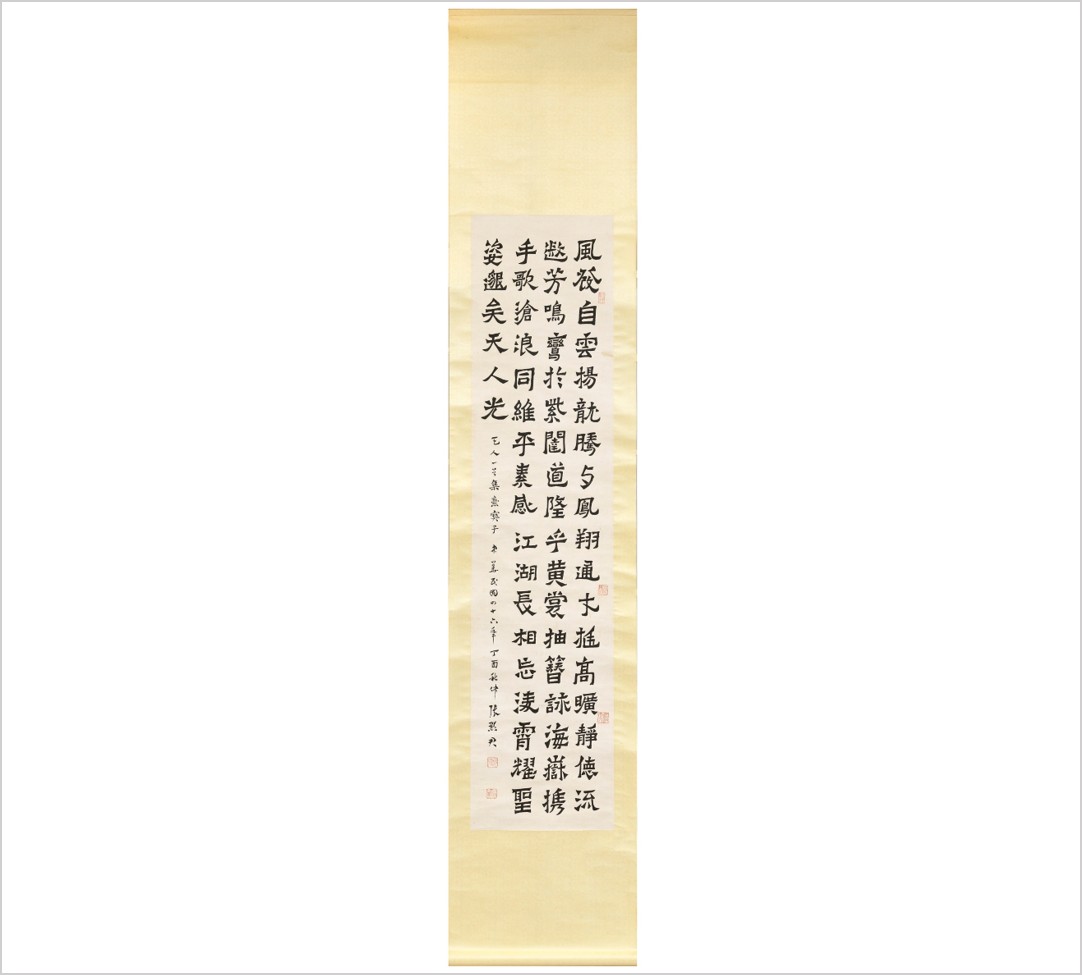
1957
Ink on paper
141.5 × 32 cm
National Museum of History
 Back to homepage
 Back
Back